
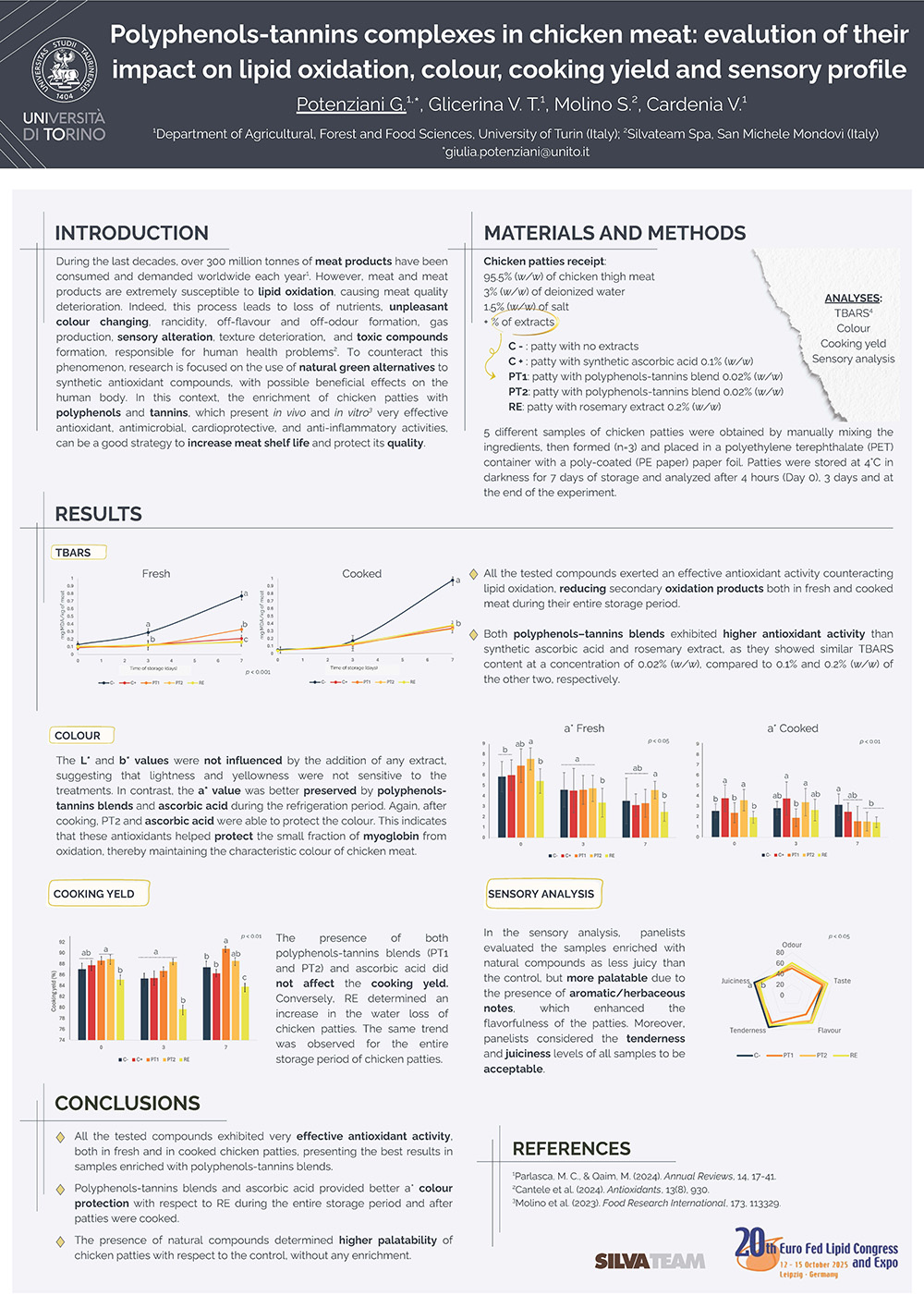
Natural compounds are receiving increasing attention in the food industry as alternatives to synthetic compounds, which, despite their efficiency, have been linked to carcinogenic effects in the human body. In this context, natural compounds, including polyphenols and tannins, could be promising alternatives for meat protection, due to their antioxidant activity. Based on this, the aim of this study was to evaluate the ability of different polyphenols-tannins blends to increase the shelf-life of chicken patties stored at 4°C for 7 days, assessing their ability to counteract lipid oxidation as related to storage and cooking process, investigating also their impact on colour, cooking yield and sensory profile of patties. Two different blends (PT1; PT2) were tested at a concentration of 0.02% (w/w) in patties. In addition, a positive control (C+), formulated with synthetic ascorbic acid 0.1% (w/w); a negative control (C-), without antioxidants; and samples enriched with a natural commercial rosemary extract (RE) at 0.2% (w/w) were prepared.
Thiobarbituric acid reactive substances (TBARS); colour according to CIELAB L*, a* and b* values; cooking yield and sensory attributes were evaluated during the whole experiment. The patties enriched with both blends presented a significantly lower amount of TBARS during the entire storage period (p<0.001), reaching a final value of 0.33 ± 0.03 and 0.17 ± 0.01 mg MDA/kg of meat, respectively, compared to 0.77 ± 0.11 mg MDA/kg of meat detected in the negative control. The same trend was also observed after cooking, where the two blends displayed a significantly lower amount of MDA with respect to all the other investigated samples, presenting the best antioxidant activity. About colour, the addition of each extract had no effect on the patties’ redness throughout the storage period. Similarly, no colour differences were observed between the control and the treated samples after cooking. Regarding the cooking yield, the presence of the two polyphenols-tannins blends did not negatively affect water retention, unlike RE, which led to greater water loss and tougher texture (p<0.05). Finally, the sensory attributes were not significantly influenced (p>0.05) by the presence of PT1 and PT2. Given these results, the inclusion of polyphenols-tannins formulations appears to be a promising strategy to counteract lipid oxidation and to enhance the nutritional profile of raw and cooked meat products, requiring a lower concentration compared to the other compounds to achieve the desired antioxidant effect with no adverse effects.