
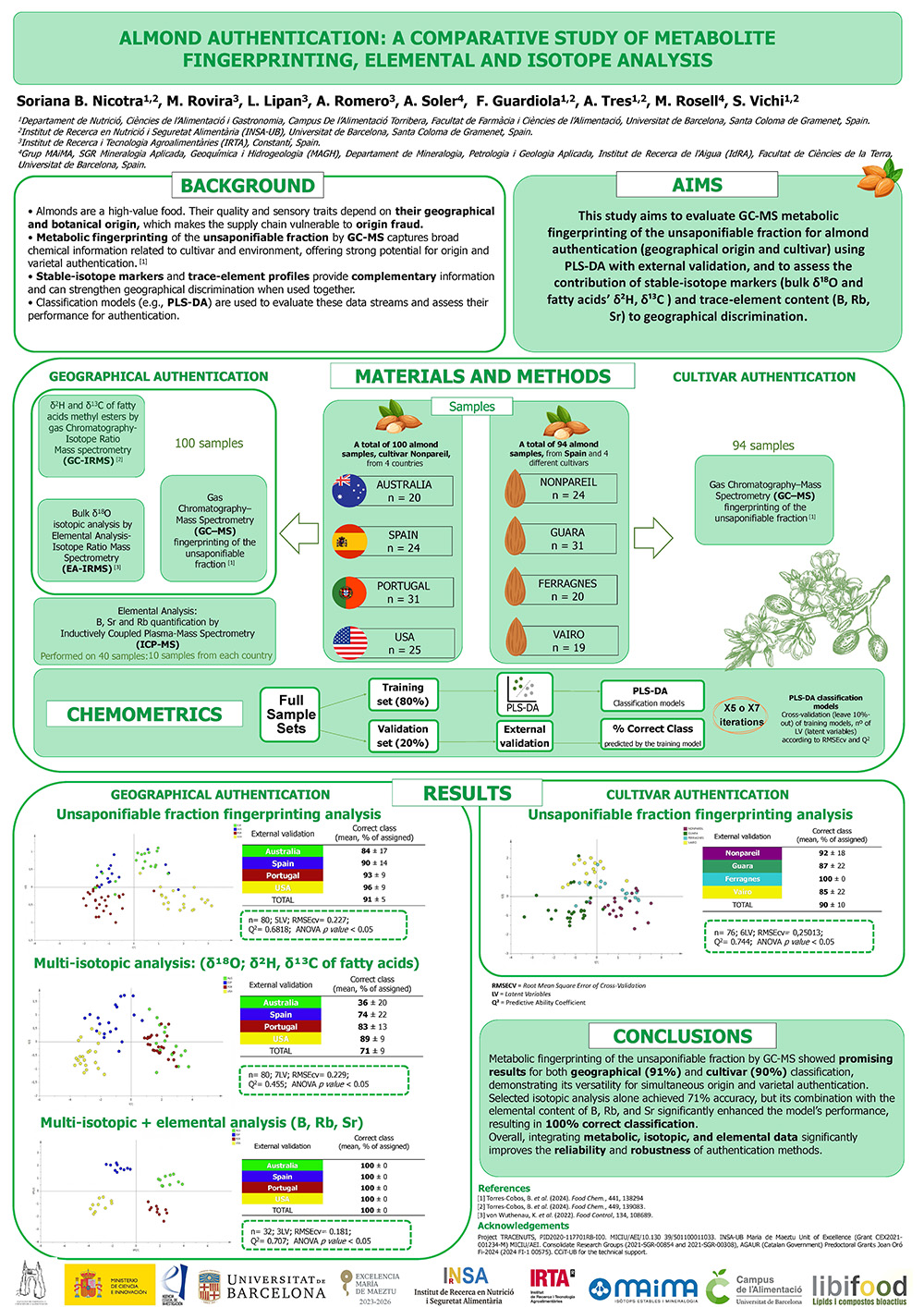
Almond production is a key agricultural sector in countries such as the USA, Spain, and Australia, but increasingly exposed to fraud risks, especially due to the geographical origin on market prices. Reliable authentication methods are therefore required to protect product integrity and consumer trust. This study evaluated two analytical strategies for almond authentication: i) trace elements and stable isotope analysis, which offers standardized measurements, and ii) metabolic fingerprinting, which uses a broad spectrum of chemical information.
The first approach focused on bulk δ¹⁸O values obtained by Thermal Conversion/Elemental Analyzer-Isotope Ratio Mass Spectrometry (TC/EA-IRMS), as well as on δ²H and δ¹³C values in fatty acid methyl esters analyzed by gas chromatography-IRMS (GC-IRMS) and the concentration of B, Sr and Rb by Inductively Coupled Plasma Mass Spectrometry (ICP-MS).
While the metabolic fingerprinting approach addressed metabolites of the unsaponifiable fraction analyzed by GC-MS. Partial Least Squares-Discriminant Analysis was applied to build classification models based on data from each method. Geographical classification of Nonpareil almonds from Spain, USA, Portugal, and Australia (n=100) achieved external validation accuracy rates of 74% using only the isotopic analysis versus 91% with the metabolic approach. Notably, incorporating trace element data to the isotopes of a 40-samples subset raised their classification accuracy to 100%. In addition, metabolic fingerprinting enabled classification by cultivar (Nonpareil, Guara, Vairo, Ferragnes, n=94), achieving an external validation accuracy of 90%. These findings highlight the strong potential of both approaches as effective tools for almond authentication.