
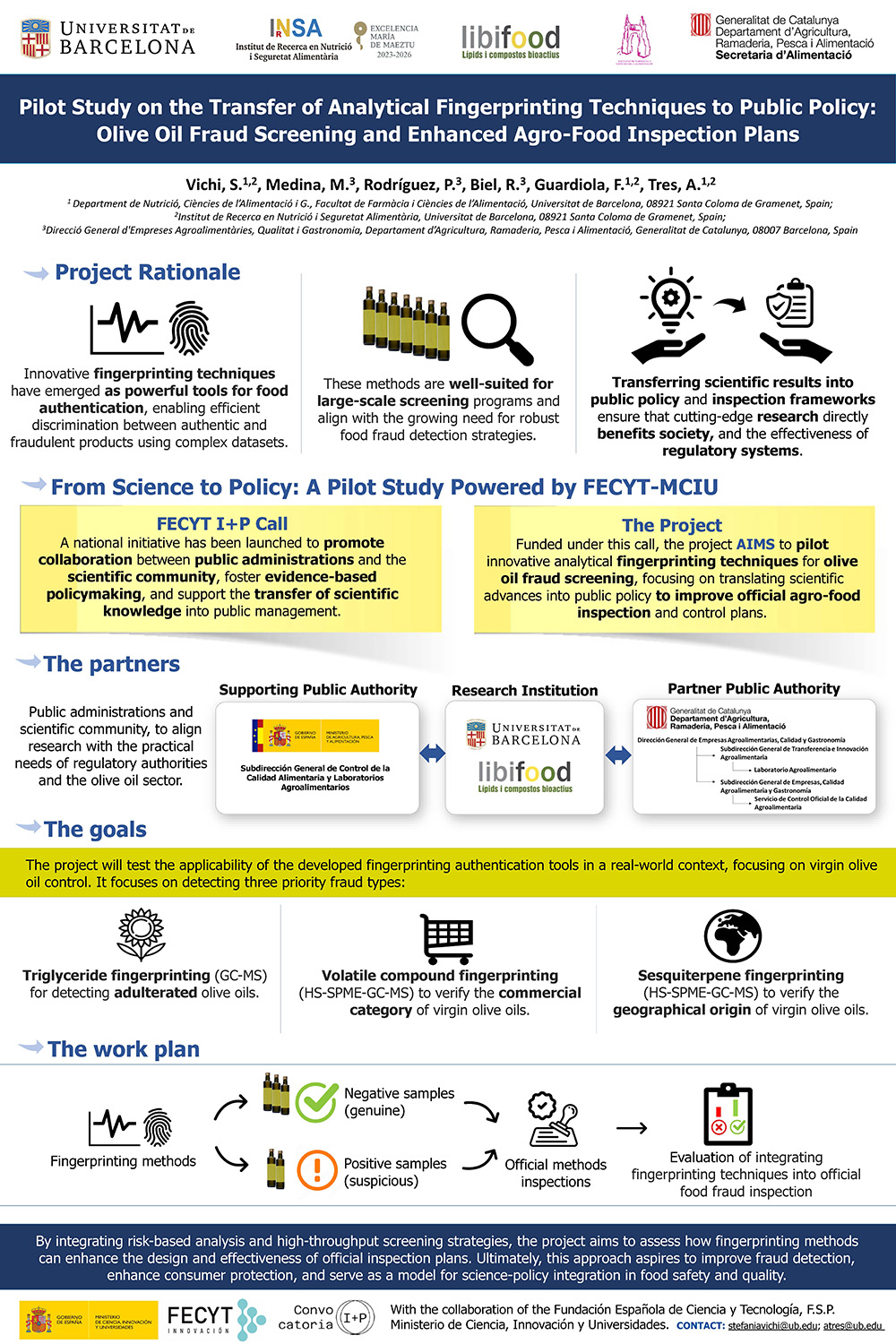
Recent developments in food authentication have introduced powerful fingerprinting techniques capable of processing complex datasets to efficiently discriminate between authentic and fraudulent samples. These methods are particularly suitable for large-scale, representative screening programs.
A pilot study aiming to evaluate innovative analytical fingerprinting techniques for food fraud screening, with a focus on transferring scientific advances into public policy to improve official agro-food inspection and control plans (FCT-24-20956), has been recently launched with the support of FECYT-MCIU (Fundación Española para la Ciencia y la Tecnologia, F.S.S.-Ministerio de Ciencia, Innovación y Universidades). The initiative represents a pioneering collaboration between public administrations and the scientific community, designed to align cutting-edge research with the practical needs of regulatory authorities and the olive oil sector.
The project will test the applicability of the developed fingerprinting authentication tools in a real-world context, focusing on virgin olive oil control. It focuses on detecting three priority fraud types: adulteration, mislabeling of commercial category, and false geographical origin, which are directly linked to high-value quality attributes and are frequent targets of public inspections. By integrating risk-based analysis and high-throughput screening strategies, the project aims to assess how fingerprinting methods can enhance the design and effectiveness of official inspection plans. Ultimately, this approach aspires to improve fraud detection, enhance consumer protection, and serve as a model for science-policy integration in food safety.