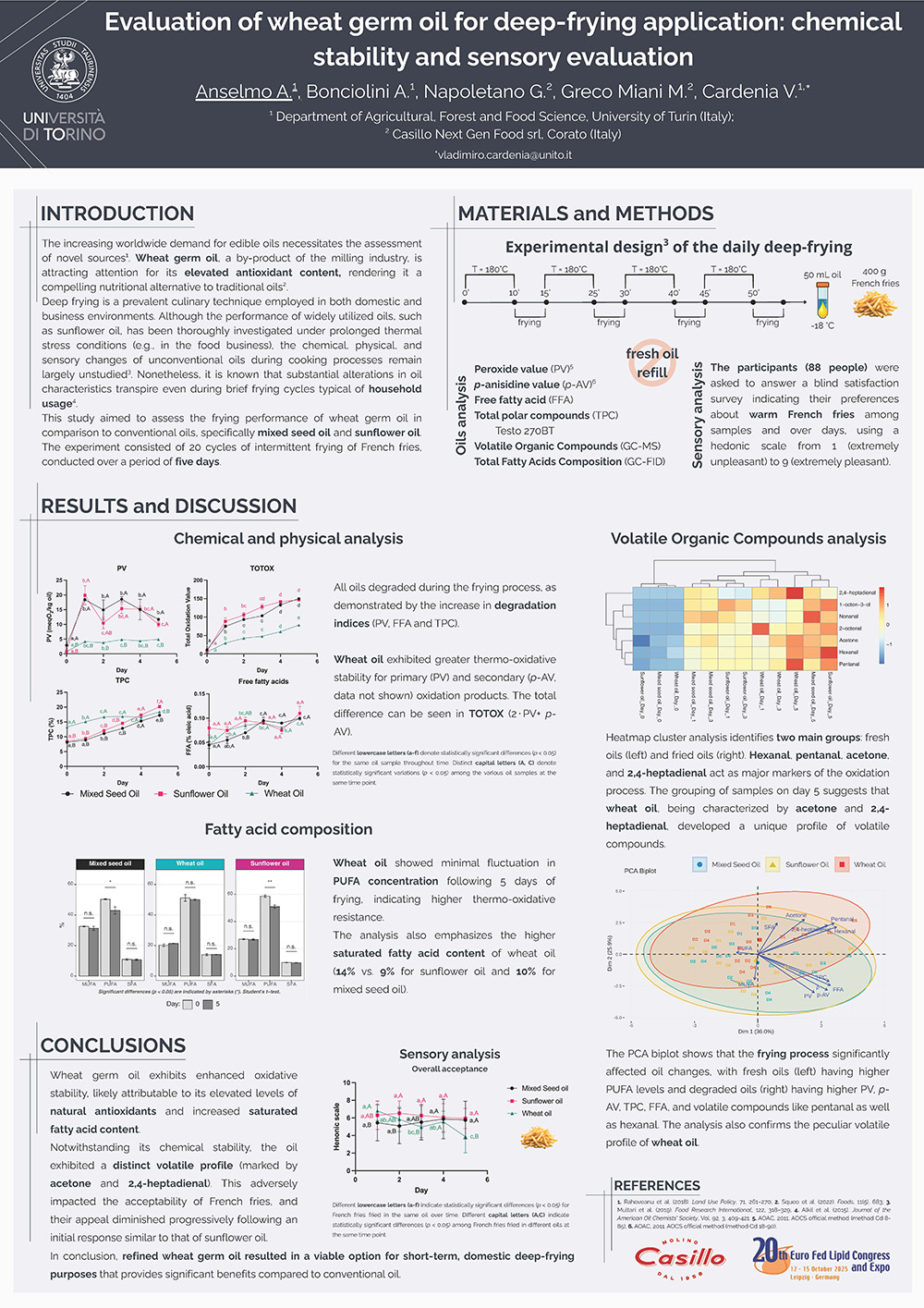
Oil degradation during deep-frying significantly affects the quality of fried foods and raises safety concerns. To date, the effects of cooking on unconventional oils are poorly investigated. In this context, refined wheat germ oil (WO) is a valuable by-product from the milling industry, recognized for its high content of antioxidant compounds. In this study, the frying performance of WO was assessed and compared to mixed seed oil (MO) and sunflower oil (SO) over five days of intermittent deep-frying of French fries (20 frying cycles in total). The frying oils were analyzed for fatty acid profile, volatile organic compounds, total polar compounds (TPC), peroxide value (PV), p-anisidine (p-AV) and free acidity (FFA). Additionally, a preference assessment on French fries was performed. All oils showed a decreasing trend (p>0.05) in polyunsaturated fatty acids (PUFAs) content and a rise in trans isomer fatty acids content, TPC (p<0.001) and FFA (p<0.05), indicating that the high temperature led to thermal deterioration. However, WO exhibited a significantly lower total oxidation value, indicating greater oxidative stability compared to SO and MO, which showed faster degradation based on the main oxidation parameters considered. The presence of naturally occurring antioxidant compounds (such as tocopherols, tocotrienols and carotenoids) as well as the fatty acid composition likely enhanced its stability. The acceptance of French fries was evaluated through hedonistic tests to assess the overall liking. The results confirmed the WO as the most favorite oil after two days of treatment. In conclusion, our data show that refined wheat germ oil is a promising alternative for domestic frying applications, offering substantial advantages over traditional options.
OXI-016: Evaluation of Wheat Germ Oil for Deep-frying Application: Chemical Stability and Sensorial Assessment