
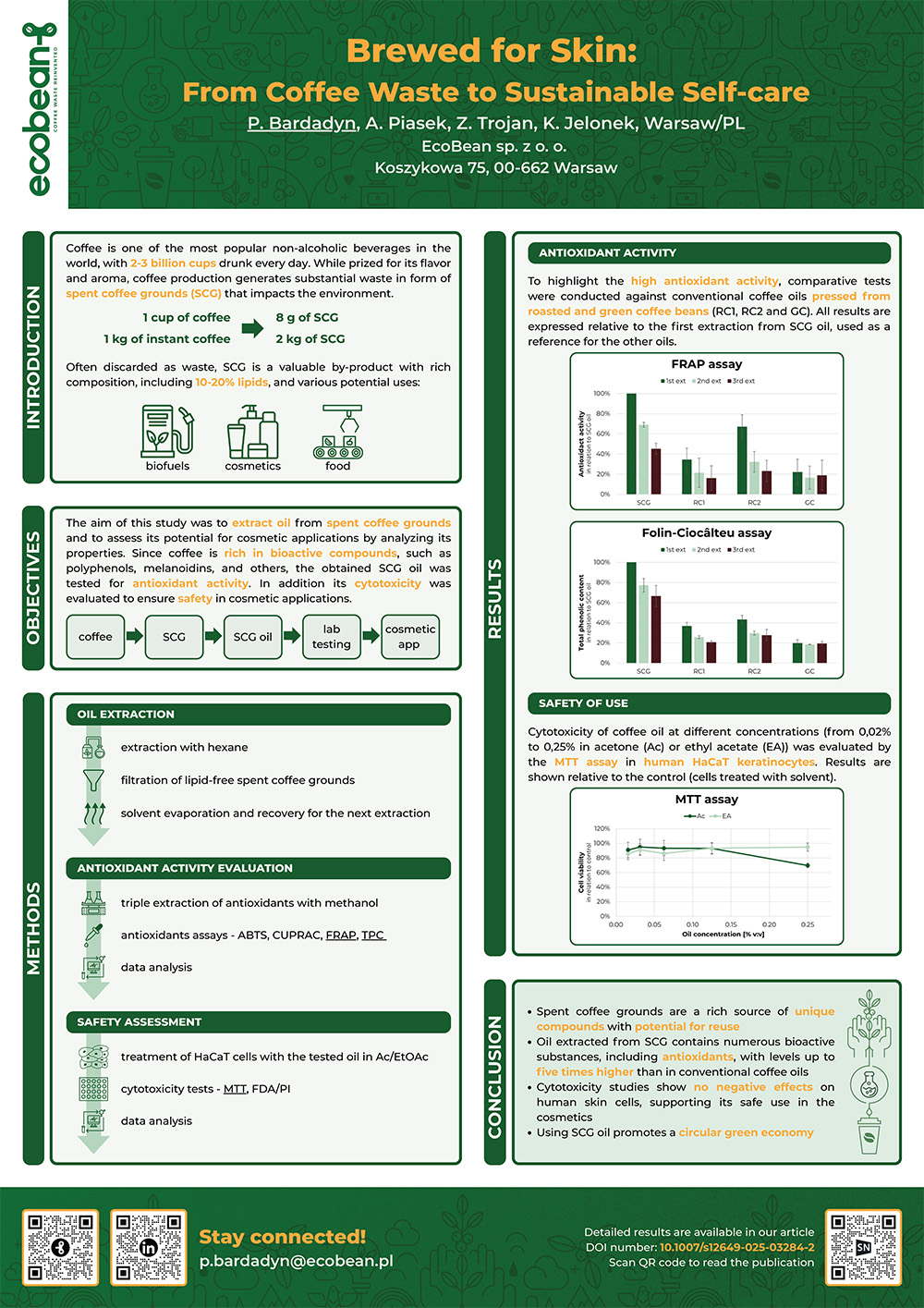
According to the International Coffee Organization (ICO), every day, people around the world consume approximately 30 million kilograms of coffee, making it one of the most popular nonalcoholic beverages. Besides its incredible flavor and aroma, we must also consider coffee’s dark side – the waste created during its production. Each cup of espresso generates approximately 8 grams of spent coffee grounds (SCG) while producing one kilogram of instant coffee results in 2 kilograms of this material.
Although often discarded as waste, it should be considered a valuable by-product with a rich composition and potential for further usage. When examining its composition, we can distinguish polysaccharides, proteins, antioxidants, lignin, and lipid fractions. Fats that remain in the grounds after brewing constitute from 10% to as much as 20% of the spent grounds. Extraction of SCG with a suitable solvent enables the recovery of coffee oil, which has great potential as a stand-alone cosmetic product or as a cosmetic ingredient. This brown liquid with a distinct coffee aroma consists primarily of triacylglycerols, which account for approximately 75% of its composition as well as smaller amounts of diacylglycerols, monoacylglycerols, and free fatty acids. The profile of fatty acids comprising the lipid fraction (esterified and in the free form) depends on many parameters, including the origin of the beans and grounds and the method of oil extraction. Its main components are linoleic acid (C18:2), palmitic acid (C16:0), stearic acid (C18:0), oleic acid (C18:1) and smaller quantities of arachidic acid (C20:0) and linolenic acid (C18:3). In cosmetics, these acids are responsible mainly for emulsification and protection against water loss. Stearic acid is also known as a gentle surfactant with possible anti-inflammatory properties, which can reduce skin redness, and linolenic acid is considered as a lightening agent in the case of ultraviolet (UV)-induced skin hyperpigmentation. Except acylglycerols and FFAs, compounds such as sterols, tocopherols and diterpenes, including kahweol and cafestol, and many others can be found. In addition, SCG oil is a substance rich in numerous antioxidants, among which chlorogenic acids and caffeine are notable. Rich composition makes that oil can be used as an ingredient in various self-care products such as creams, makeup removers, body butters, massage oils, face serums, or hair care products. Sourcing it from waste rather than coffee beans offers more sustainable and environmentally friendly product than commercially available coffee oils. This approach aligns with the principles of the circular economy, offering an innovative and holistic solution for the problem of coffee grounds.