
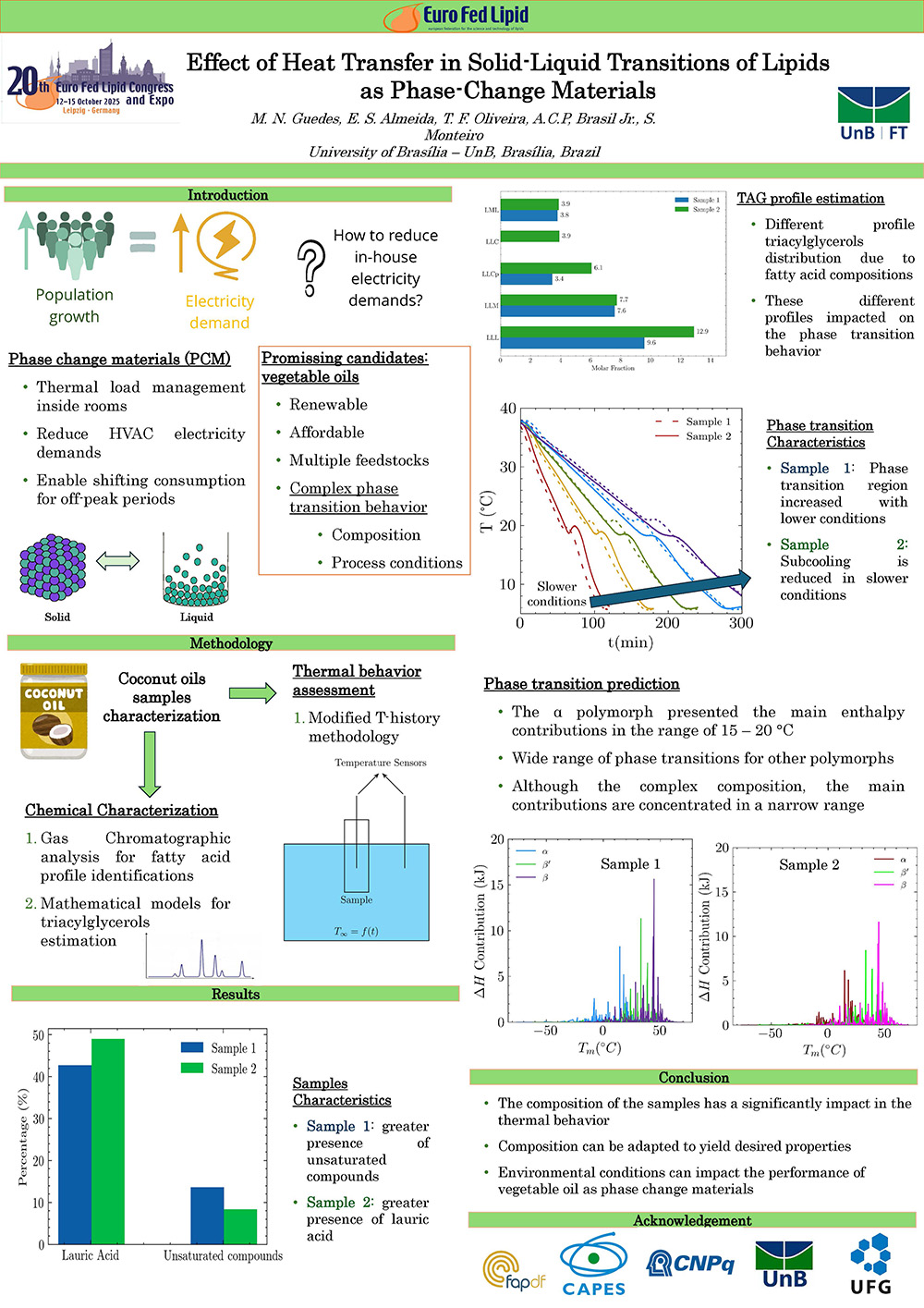
This study investigates the impact of heat transfer on the polymorphism of coconut oil samples with varying compositions used as phase change materials. Traditional analysis of vegetable oil thermal behavior via Differential Scanning Calorimetry (DSC) faces limitations due to small sample sizes (1–10 mg) and cooling rates exceeding natural ambient fluctuations. This study employed an adapted T-history method using larger samples (5 g) and slower cooling rates (0.01–0.3°C/min), achieved by cooling from 50°C to 5°C over 2–6 hours with high-precision thermocouples (±0.05°C).
The approach—utilizing 1000x more material and rates 10x slower than DSC—better replicates real thermal storage conditions by minimizing thermal gradients and enabling bulk-phase crystallization analysis, particularly for assessing melting temperatures and subcooling effects in coconut oil. The AOCS gas chromatography method determined the fatty acid composition, which was subsequently used as input for thermodynamic modeling tools. This compositional data enabled the prediction of phase-transition behaviors, which were then compared to experimental results obtained through thermal analysis techniques. The experimental results demonstrated that the applied cooling rates directly modulated crystallization behavior, with slower rates favoring stable polymorphs and faster rates inducing metastable phases. Specifically, slower cooling at a rate of 0.01 °C/min resulted in minimal subcooling behaviors, while rapid cooling at 0.3 °C/min resulted in significant subcooling effects. Furthermore, the composition of the samples also played an important role in the formation of crystalline phases, as outlined in existing literature. When comparing experimental data with predicted values, it suggests that the α polymorph is favored under faster cooling conditions, whereas the β polymorph is preferred under slower conditions. These findings provide a framework for optimizing the functionality of vegetable oils in phase change applications by strategically designing their composition and controlling thermal conditions.