
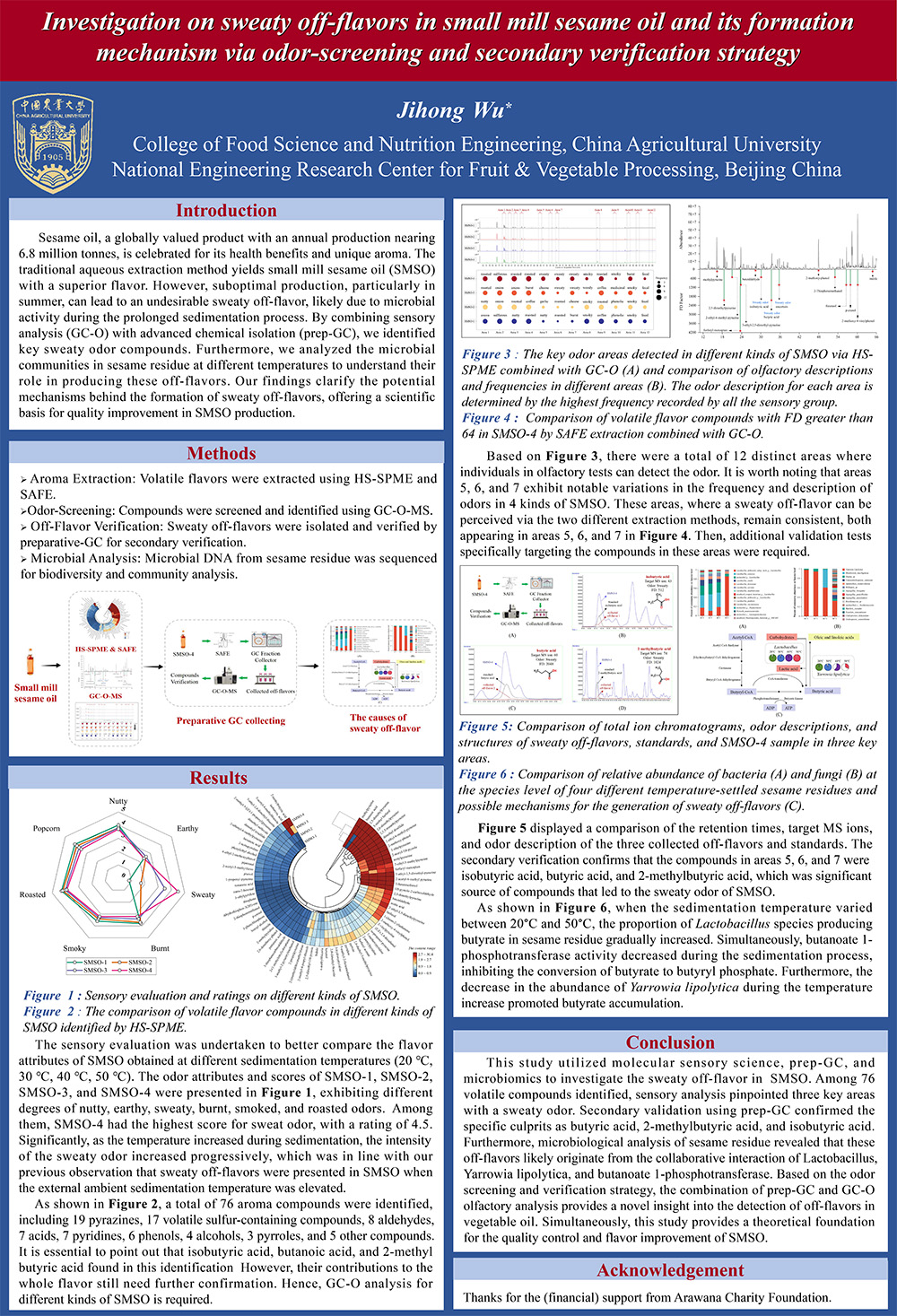
Abstract: The distinctive and enjoyable aroma of small mill sesame oil originates from the aqueous extraction process. However, in the sedimentation stage of industrial production, when the external ambient temperature is elevated, there may be the presence of unpleasant sweaty off-flavors from an unknown source. In this research, the sensomics concept and preparative gas chromatography were used to conduct an in-depth investigation on sweaty off-flavors of small mill sesame oil obtained at different sedimentation temperatures. The validation utilizing solvent assistant flavor evaporation with preparative gas chromatography confirmed the sweaty off-flavors were butyric acid (maximum OAV= 100), 2-methylbutyric acid (maximum OAV= 36), and isobutyric acid (maximum OAV= 17). The concentration of three off-flavors in all small mill sesame oil ranged from 0.03 to 7.29 mg/kg. Furthermore, microbiological investigations of sesame residues gathered during the sedimentation process at various temperatures revealed that sweaty off-flavors were mostly attributed to the collaborative interaction of Lactobacillus, Yarrowia lipolytica, and butanoate 1-phosphotransferase. This study offers a fundamental theoretical foundation for the enhancement of quality control and flavor of small mill sesame oil.
Keywords: small mill sesame oil, sedimentation, sweaty off-flavor, preparative gas chromatography, microbiomics.